The Ultimate Guide to Creating a Believable Fantasy Map
A fantasy map meaning extends far beyond a simple illustration of land and sea; it is the vital connective tissue between a creator’s imagination and a reader’s immersion. Whether drafted for a sprawling epic novel or a high-stakes tabletop campaign, a well-executed fictional map provides the spatial fidelity required to make an impossible world feel tangible. As the adage goes, “being lost is only about not knowing where you are going.” By crafting a cohesive worldbuilding map, you ensure your audience is never truly lost, but rather invited to explore the history and logic etched into every coastline and mountain range.
Fantasy Map Explained: Understanding the Three Main Types
In professional cartography, we distinguish between representational and exact elements. Representational icons—such as a star for a capital or a single mountain peak icon—convey the existence and relationship of a feature rather than its true physical footprint. For instance, at a 10-mile hex scale, a major river might be drawn 5 miles wide simply to ensure it is visible, even though no such river exists in reality.
| Map Type | Focus & Scale | Grid & Accuracy |
| Outdoors Maps | World, continent, or regional geography. | Hexagon grids; mostly representational icons for landmarks and terrain. |
| Blueprints | Relational space for dungeons or structures. | Square grids; accurate layout of rooms and structural elements. |
| Battlemaps | Tactical, high-detail areas for miniatures. | Square or Diamond grids; exact “ground-level” representation of every wall and obstacle. |
The Ten Commandments of Believable Geography
To ensure your fantasy map survives the scrutiny of a discerning audience, you must respect the basic tenets of natural science—unless you have an intentional, magical reason to defy them.
- Rivers Join, Don’t Split: Rivers are the veins of your world. They flow together into larger streams as they seek the sea. The only natural exception is a delta, where sediment creates a swampy watershed of small, shifting distributaries at the river’s mouth.
- Flow to the Lowest Point: Water is governed by gravity and follows the path of least resistance. It meanders from high elevations toward the ocean, avoiding hills and cutting through soft ground.
- Single Lake Outlets: A lake can have many inlets but typically only one drainage point. Equilibrium in landlocked lakes (like the Caspian Sea) is usually maintained through evaporation, not multiple exit rivers.
- No Coast-to-Coast Rivers: A river starting at one ocean and ending at another is a geographical impossibility; such a feature would actually indicate two separate landmasses divided by a sea.
- The “Lonely Mountain” Rule: Mountains rarely stand alone. They are typically the result of large-scale tectonic forces. Single peaks are almost always volcanic (like Mt. Kilimanjaro) or magical in origin.
- The Rain Shadow Effect: Prevailing winds carry moisture to one side of a mountain range, creating lush forests. As the air passes over the peaks, it loses its moisture, leaving the leeward side arid and desert-like.
- Plate Tectonics & Subduction: For high-fidelity worldbuilding, imagine your continents as a puzzle (like Pangea). Mountains often form through subduction, where one tectonic plate slides beneath another, forcing the crust upward on the non-subducting plate.
- Settlement Logic: Civilizations are opportunistic. Cities cluster near freshwater sources for agriculture and trade, or at strategic mountain passes.
- Sheltered Ports: A port city belongs in a bay, harbor, or inlet. Placing a port on an exposed, straight coastline leaves ships vulnerable to the full force of the sea.
- Climatic Common Sense: Maintain a logical gradient. Frigid regions belong near the poles, while tropical and arid zones should center around the equator, influenced by the tilt and size of your globe.
Tools of the Trade: From Rice to Software
An expert cartographer chooses tools based on the desired output, whether that is a unique hand-drawn aesthetic or a scalable vector digital file.
Analog Methods
- The Bean Method: Scatter dried beans to determine landmass shapes. This allows you to “find” your world before committing to ink.
- The Rice Fantasy Map: Pour rice over paper and trace the edges. This is the gold standard for creating organic, jagged coastlines that feel weathered by time.
Digital Software
- WonderDraft ($29.99): A one-time purchase tool for Windows/Mac. Pros: Excellent for tracing imported sketches; you own 100% of the commercial rights. Cons: Limited to the art styles provided in the base or additional packs.
- Inkarnate (Free/Subscription): Browser-based and feature-rich. Pros: Access to 19,000+ assets and 8K resolution exports for Pro users. Cons: Commercial use is strictly tied to an active subscription; if your sub lapses, you may lose the right to sell new work using those assets.
- Azgaar’s Fantasy Map Generator: A free, open-source procedural tool. Pros: Generates religion, culture, and height layers instantly. Cons: Less artistic control than manual software.
- World Anvil: The premier site for organizing lore, featuring interactive map layering and “pins” for worldbuilding.
- Campaign Cartographer 3 (CC3+): Professional, CAD-based software. Pros: Unmatched precision and “professional-level” detail used by published authors. Cons: Extremely steep learning curve; best suited for those comfortable with technical design.
AI Generation
Tools like Midjourney or Gemini can generate stunning “vibe” maps. However, they currently lack the editability required for specific story needs. Use them for inspiration or to generate base terrain shapes you can later refine.
Step-by-Step Construction Process
- Define Landmasses: Use jagged, non-smooth lines. Real coastlines are shaped by erosion and tectonic drift.
- Place Terrain Features: Use the “S-line” method to plot the spine of your mountain ranges first. Add foothills to transition the elevation into plains.
- Add Waterways: When drawing a meandering path, remember you are deciding the low points of the land. Rivers must weave around the hills you placed in step two.
- Map Settlements: Place your major capitals at river deltas or deep-water harbors.
- Refine and Ink: Always plan in pencil. When moving to ink, leave “white space” gaps in your terrain for labels. Overlapping text on dense forest icons is a hallmark of amateur design.
Practical Tips
- Line Weight: Add depth by using a thicker line on the southern or “shadow” side of coastlines to simulate a 3D effect.
- Easter Eggs: Include names that hint at history (e.g., “The Giant’s Fall”) to suggest events that happened before the story began.
- Antique Staining: For a physical map, stain your paper with dark roast coffee. Unlike breakfast roasts, a dark roast provides the high-contrast, aged parchment look required for professional aesthetics.
Best Practices
- Start Small: Master a single province or archipelago before attempting a global worldbuilding map.
- Consistent Iconography: Follow the advice of master cartographer Herwin Wielink: distinguish your forests by shape. Use sharp “leaf” shapes for pines and rounded “flower” shapes for oaks to keep the map readable.
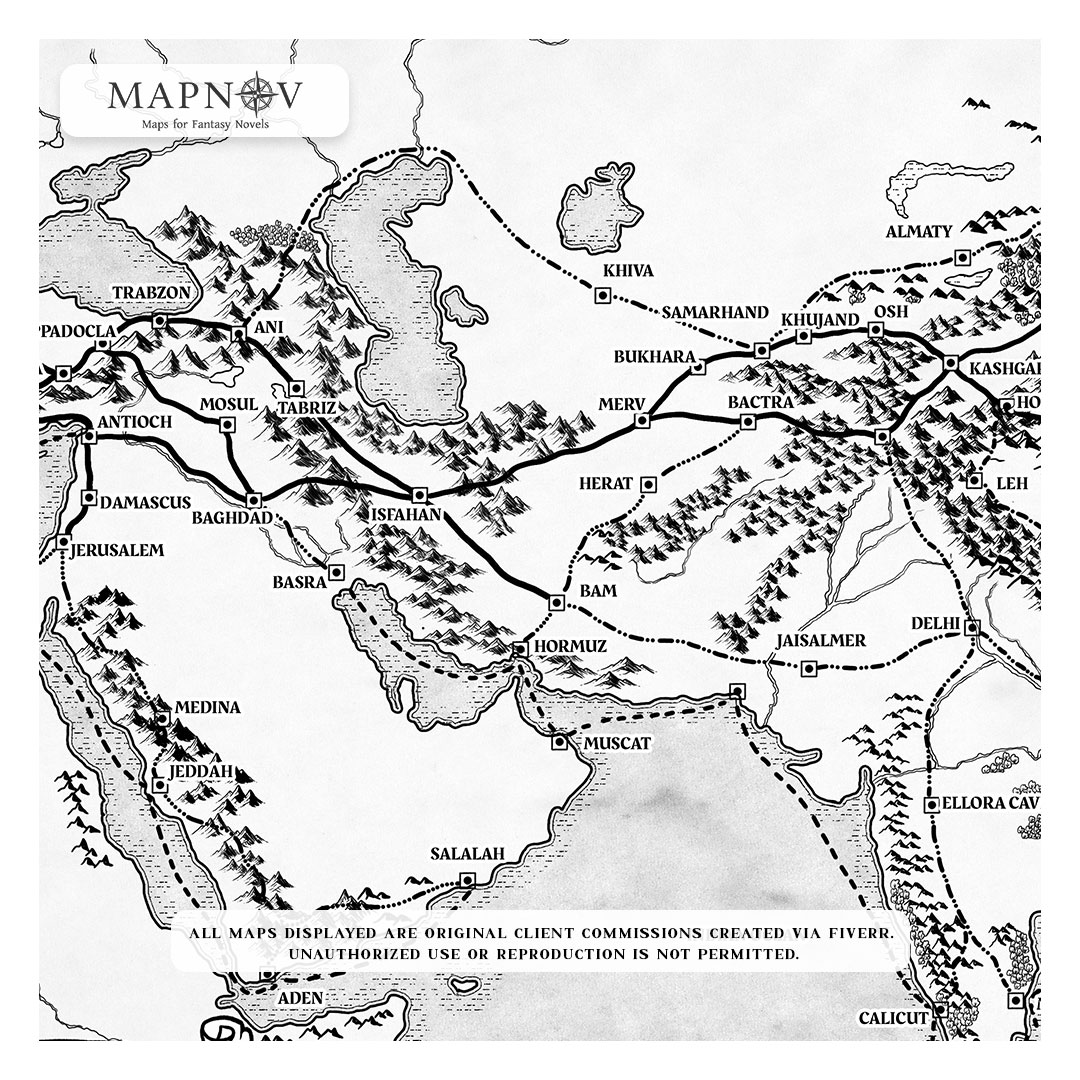
- Artistic Flourishes: A decorative border and a well-designed compass rose elevate a functional diagram into a piece of art.
Common Mistakes to Avoid
- Water Defying Gravity: Avoid rivers that cut across entire continents or flow toward higher terrain.
- Geometric Landmasses: Perfectly circular islands or square continents feel artificial.
- Label Stuffing: Do not feel the need to name every forest and stream. Leave room for the reader’s imagination to breathe.
Frequently Asked Questions (FAQs)
Can I have a river that splits? Only in a delta or a “braided” stream in very flat areas. Otherwise, a split river requires a magical explanation.
Do I need to be an expert in geology? No, but you should understand the logic of why things are where they are. If you break a rule, do it with intent.
What is the best scale for a novel map? Wide enough to encompass the journey’s milestones, but narrow enough to maintain a sense of mystery.
Why does Middle-earth have a “Lonely Mountain” (Erebor)? In the real world, a “lonely” peak is usually a volcano (like Kilimanjaro). In Middle-earth, Erebor is actually situated near the Gray Mountains and the Iron Hills, making it less isolated than it appears in close-up views.
Conclusion
A fantasy map is the ultimate bridge between the author’s vision and the reader’s understanding. By grounding your world in the logic of geography and utilizing the right digital or analog tools, you create a setting that feels ancient and alive. While the laws of science provide the foundation, your world is ultimately a product of your imagination—use magic to break the rules, but use your map to make those breaks feel like part of the legend.
Ready to chart the unknown? Start your first worldbuilding map today by experimenting with the rice method or diving into the professional suites of WonderDraft or World Anvil. Your world is waiting to be found.